Post-production
ADR editor
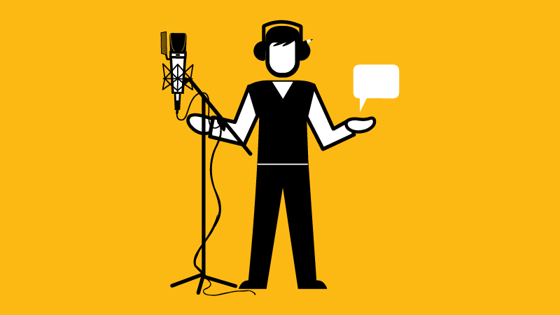
What does an ADR editor do?
An ADR editor records the additional dialogue needed to complete a feature film, television drama and sometimes a documentary. ADR stands for ‘automated dialogue replacement’ and is also referred to as ‘post-syncing’. It’s essentially recording extra dialogue in the studio after the film has been captured.
There are lots of reasons why you might need to re-record dialogue or record new dialogue. It could be because it was impossible to capture on location due to too much background noise. Or it might be because the script needs to be changed to improve the story or fill in a gap when a scene has been cut. Or it could be because the actor made an error or failed to deliver the lines clearly.
The technique for re-recording the dialogue requires a specially equipped studio where the ADR editor can loop the sequence that needs the new dialogue. This means a short sequence can be played over and over again on a screen and the actor can precisely match their original performance, both in terms of character and lip-sync. ADR sessions are usually attended by the director who can advise the actor and make sure the performance is correct.
New dialogue may be recorded for a number of other reasons, too. For example, it could be that the language is too explicit for TV, so a child-friendly or pre-watershed version needs to be created. Sometimes it’s necessary to replace all the dialogue in a film in order to create a foreign-language version. Another scenario is that a musical performance recorded on location by an actor has to be replaced in ADR by a first-class singer.
An ADR recordist is most likely to be freelance, but occasionally they are on the staff of a large film studio or post-production house. They are part of the sound family and they may go on to work as dubbing mixers or location recordists.
Read
- What is ADR in Film? A Beginner’s Guide for Directors and Editors
- Everything you need to know about ADR in film (and didn’t know to ask)
- What is an ADR editor?
What’s an ADR editor good at?
- Understanding sound: know how acoustics work, create a close match between sound on location and the sound in the studio
- Using audio software: have an in-depth knowledge of digital sound recording software
- Using audio hardware: understand the different types of microphones, be able to select the best one for the effect being created
- Diplomacy: be able to work with actors who might be nervous or frustrated by what can be a long, painstaking process
- Collaboration: support the director in trying to get the best performance from the actors
Who does an ADR editor work with?
An ADR editor works very closely with the directors and actors.
How do I become an ADR editor?
There are no set routes to becoming an ADR editor, but many people work their way up from being runners in a post-production or audio post-production house.
At school or college:
To study a sound-related course at university, it’s useful to have A-levels or Highers in maths, physics, electronics or music. Or you might want to take a level 3 vocational qualification. Have a look at what your local college offers in those subjects and search training providers such as Pearson and City & Guilds.
Build a portfolio:
Make your own sound. Create a body of work that you can show off to employers. Go to Build your sound portfolio to learn how.
Get an apprenticeship:
Apprenticeships are work with training, so they can be a great opportunity to earn as you learn. You might find an apprenticeship as a post-production technical operator in a post-production company. This could give you good experience of managing files, as well as useful contacts in the post-production industry. If you continue to compose and learn about music, it’s possible you could build up to the role of music editor.
Check out What’s an apprenticeship? to learn more about apprenticeships and Find an apprenticeship to find one in your region, or approach companies directly. Go to ScreenSkills' Information on apprenticeships for the main apprenticeship schemes in screen.
Get a degree:
It’s not necessary to have a degree to be an ADR editor, but you might want one in sound engineering. A degree could help you go on to higher-grade jobs such as supervising sound editor. You might also do a first degree in another subject, like maths or music, and then specialise in sound at post-graduate level. Have a look at ScreenSkills’ list of recommended courses in film and TV. We recognise courses with our ScreenSkills Select award where they offer training in the relevant software, dedicated time to building a portfolio and have strong links with the film and TV industries.
Take a short course:
Go to the list of training courses recommended by ScreenSkills and search for ‘sound’.
Volunteer:
Take part in drama productions. Learn about performance and acting. Record sound for student videos.
Search for jobs:
Research post-production houses. Regularly check their websites to see if they are advertising for junior roles. Check out ScreenSkills job boards and Animation UK job vacancies. Send in your CV and ask if they’re recruiting.
Meet people in the industry:
Go to ScreenSkills’ events, follow your local film office and any local community arts and media organisations and attend their events. Go to how to network well for some tips.
Network online:
Create a LinkedIn profile. See if there’s a Facebook page or other social media group for people making films or videos in your area. Join it and take part. Create a ScreenSkills profile.
Explore ScreenSkills Resources:
ScreenSkills careers information:
The your career hub has a wealth of resources designed to help you start or progress your career.
ScreenSkills e-learning:
ScreenSkills has a suite of free e-learning modules for those who are over 18 which can improve your knowledge. The ScreenSkills Passport modules also prepare you as they are essential for some production roles. Some modules are available for those under 18. For anyone wanting advice about first steps, the Getting into the screen industries modules are very useful.
ScreenSkills skills checklists:
If you would like more detail about the tasks, responsibilities and skills required for many key roles in film and TV drama, children’s TV and unscripted TV you can look at our skills checklists.
You might also be interested in...
Being a sound recordist in unscripted TV. There are also openings in commercials and corporate and music videos. Or you might want to be a sound editor in post-production.
Further resources
- Sound for moving pictures
- The Association of Motion Picture Sound (AMPS)
- Institute of Professional Sound (IPS)
- Community Media Association
- Hospital Broadcasting Association
- Professional Lighting and Sound Association (PLASA)
- Perspective, a forum for film, TV and media composers
- The Audio Engineering Society
- Sound and Music
- Eleanor Adler
- Post-production runner: my first job in film
- Bectu (the media and entertainment union)
- Bectu Ratecards
- ScreenSkills resources directory